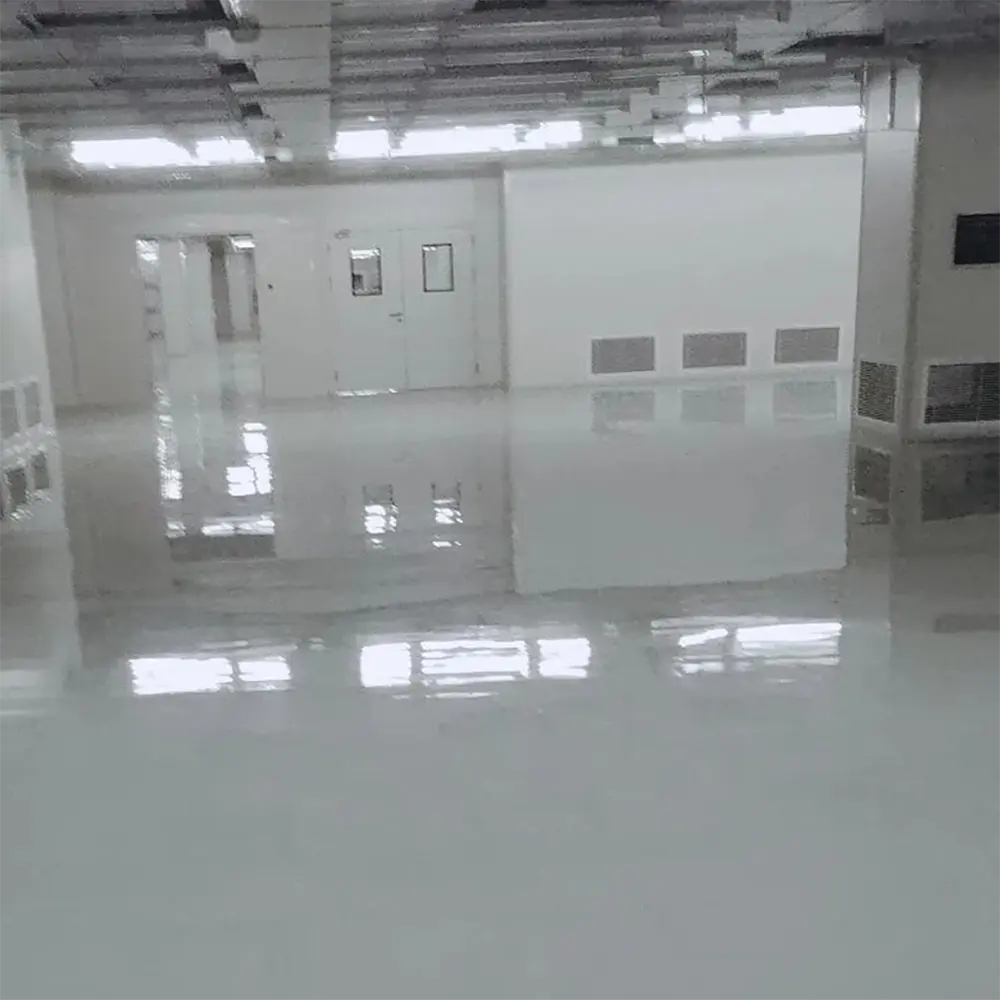
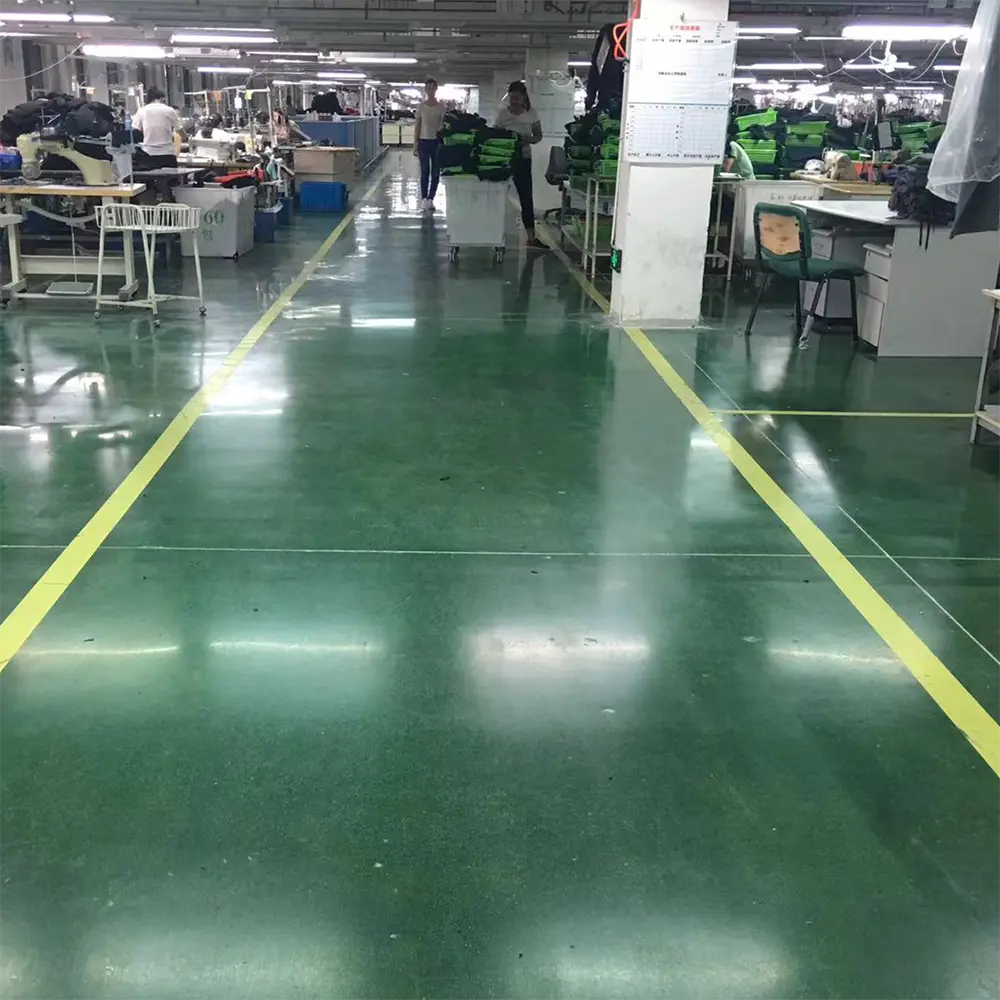

Product Application
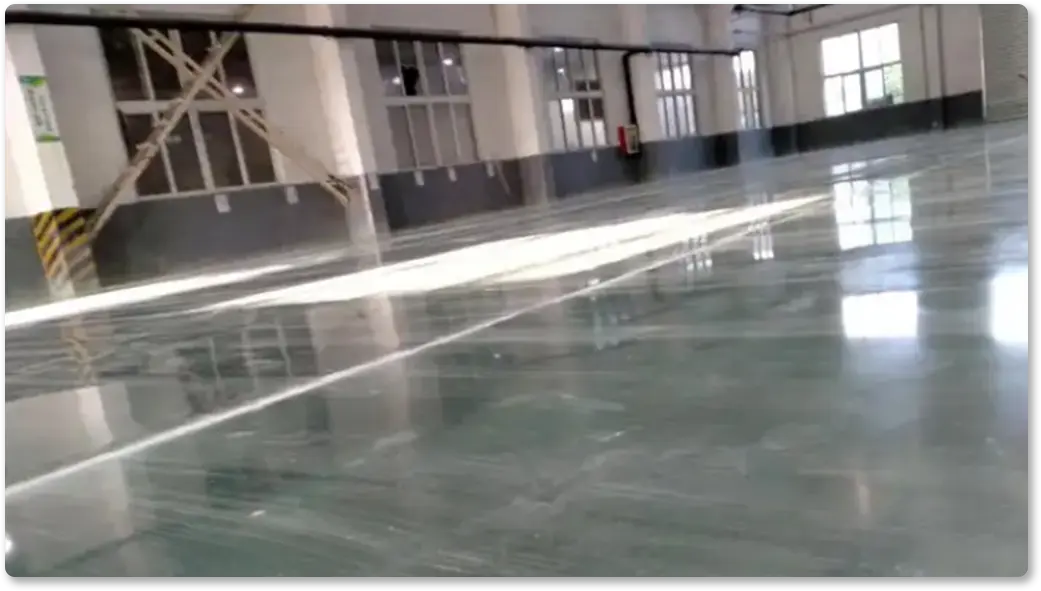
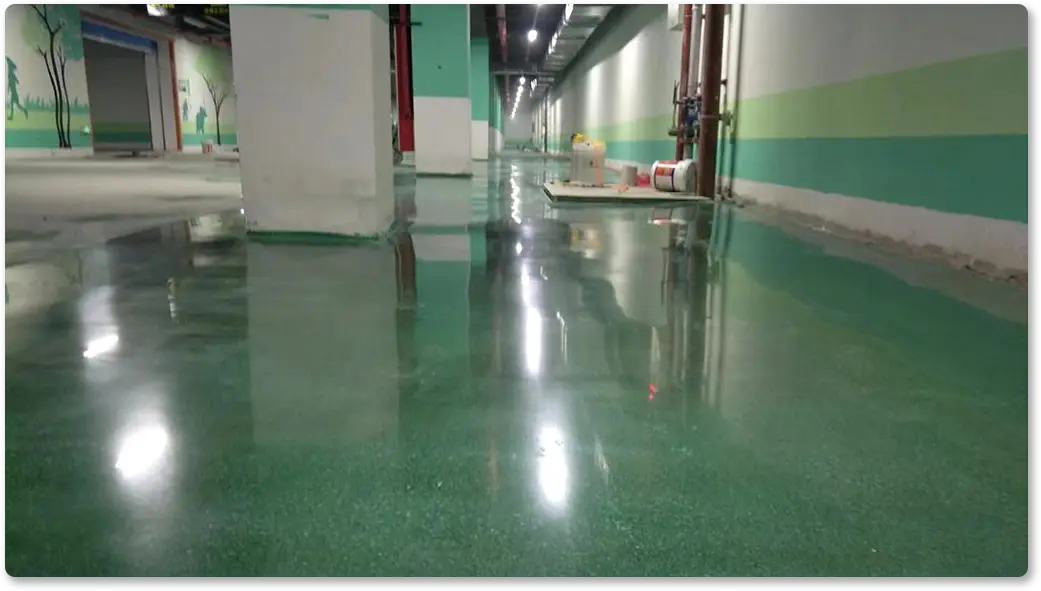
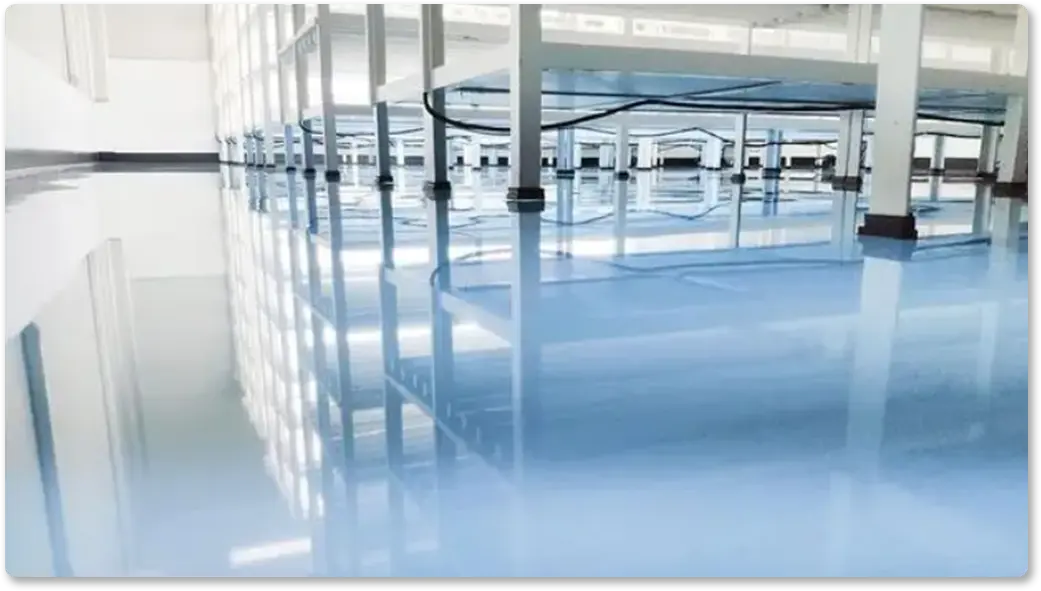
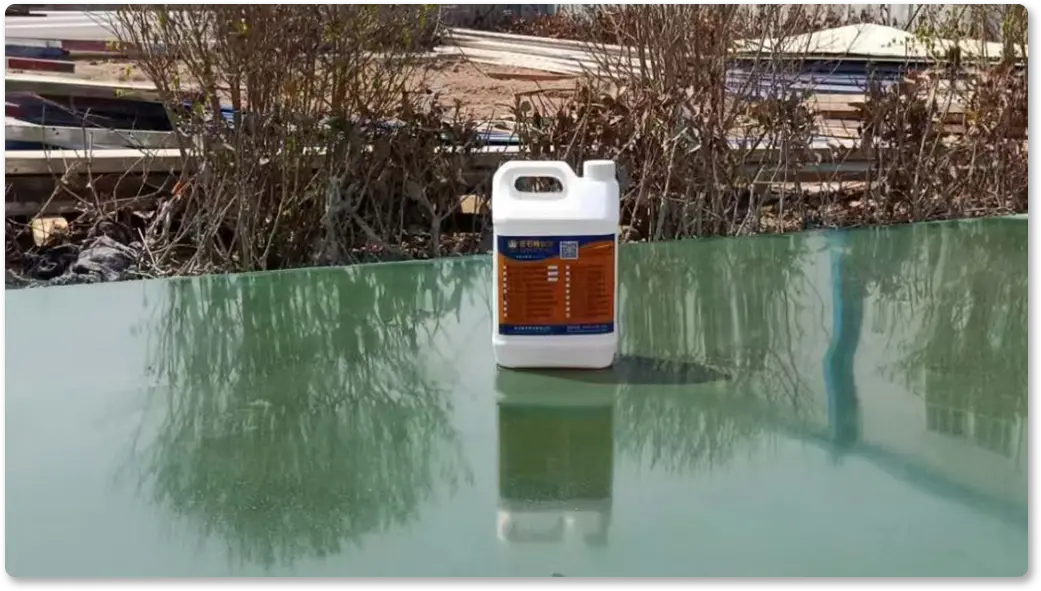
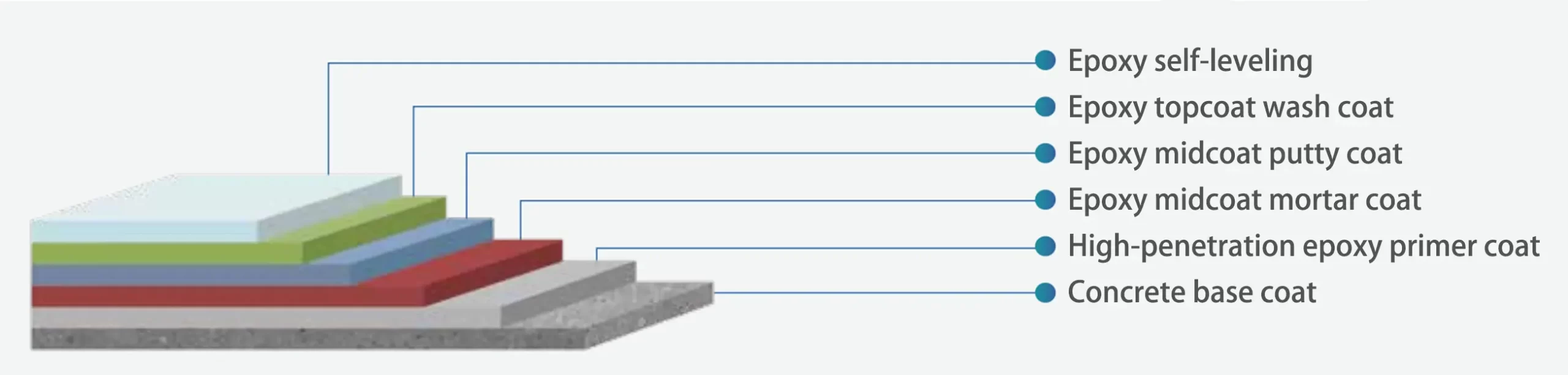
Colored Emery Coating Structure
Construction Process
| Process name | Specific practices and requirements |
| Surveying and laying out | (1) Review the entire site according to the elevation points given by the general contractor, mark the 1M line of the building on the wall and column surface, and check the height between the cushion layer and the final finished surface to determine the thickness of the final concrete layer. (2) According to the compartment design, the compartment size is specified to be no more than 40M, and the one-time pouring is controlled within 1500M2. |
| Clean up the base | To increase the contact surface and adhesion between the concrete surface layer and the structural layer, use a special concrete milling machine to mill the original concrete surface layer, remove the surface slurry layer, and make the concrete base surface form a groove-shaped rough surface; then use sweeping and vacuuming (use a high-pressure water gun or high-speed sweeper when necessary), and use manual chiseling to clean the uneven base and debris, and finally rinse with water to keep it moist. |
| Set up the formwork | Arrange the construction area in a reasonable operation sequence in advance, and then support and fix the steel or wooden formwork according to each construction area. (1) Formwork support: According to the layout position, expand the formwork 10MM along the compartment line, and use the steel bar + channel steel fixing method. After fixation, use a level to adjust the surface elevation of the armor seam to make it consistent with the floor elevation, and the error is controlled within +1MM. (2) In the pouring area, 20MM thick extruded boards are used as isolation boards at all wall edges and column bases. The isolation boards are slightly higher than the floor elevation. The part that is higher than the floor after concrete pouring will be cut off after the concrete construction is completed. Ensure the continuity of the extruded boards on the wall and column edges, and fix them reliably to avoid loosening during concrete pouring. |
| Sweep the ground | Sweep the slurry before pouring concrete, about 1 hour before pouring. (1) Soak the ground (preferably more than 8 hours). (2) Absorb the accumulated water in the low-lying areas. (3) Sweep the slurry, just wet the surface (you can use slurry mortar, then sprinkle water to wet the slurry). |
| Tie up the steel bars and pour on the concrete | (1) Place the steel mesh according to the design drawings, and ensure that the steel mesh is placed in the upper part of the middle layer of the concrete (using pads). (2) First, manually flatten the concrete according to the floor elevation. (3) The concrete is directly delivered to the platform by a conveyor to increase the unloading speed. To ensure the quality of the concrete floor paving, arrange 2-3 or more concrete pouring workers to cooperate and flatten the surface of the concrete spread on the ground so that the pile is slightly higher than the design elevation (about 20-30MM). (4) At the same time, for the parts near the wall, exposed pipelines, columns, and the surrounding of the formwork, the concrete material about 20-50 cm away from the wall, column (formwork) is vibrated and leveled with a manual vibrator and a horizontal scraper. (5) The width of the concrete material laid on the ground each time shall not exceed 5 meters, and the length shall be based on the template boundary. The construction direction is from left to right (along the short side direction) and from front to back (along the long side direction). The recommended daily pouring volume is 1500-2000 square meters. Calculated based on 8 hours of work per day, the feed rate is required to be 20-30 cubic meters per hour. (6) Immediately use a large laser leveler or vibrating beam to level the areas where the edges and corners have been vibrated to ensure the flatness of the floor. Use a guide rail vibrating beam for leveling in the shelf area and a laser leveler for construction in other areas. (7) After the leveler is leveled, use a manual leveling scraper to perform a second leveling to remove floating objects on the concrete surface and improve the surface flatness again. |
| Construction of diamond wear-resistant aggregate | After the concrete has initially been set, if there are shallow footprints left on the concrete surface after stepping on it, first use a trowel to dry-grind the surface. After the dry-grinding is completed, spread the hardener. The spreading method uses two methods: mechanical spreading by a spreader and manual spreading. The spread is carried out evenly in two batches according to the specified amount of wear-resistant materials. The order is as follows: (1) Spread about 2/3 of the wear-resistant materials evenly for the first time without adding water. (2) After the wear-resistant material absorbs a certain amount of water from the concrete (the surface wear-resistant material is wet), use a single-disc or riding double-disc heavy-duty grinder to grind and slurry. (3) After the wear-resistant material hardens to a certain stage (about 2 hours), the second spreading operation is carried out, and 1/3 of the remaining amount is spread. After the second layer of wear-resistant material absorbs a certain amount of water, it is smoothed again with a double-disc polishing machine. (4) After hardening to a certain degree, use a heavy-duty double-disc polisher to polish the surface. (1) Adjust the operating speed and angle of the polishing machine according to the hardening condition of the concrete. (2) Each step of grinding and polishing is guaranteed to be at least twice; depending on the weather and environmental conditions of the day and the requirements for surface gloss. (3) The polishing of the periphery and corner areas of the column is carefully carried out by hand, and a thin steel trowel is used for matte, to eliminate grinding marks and to finish the corners. |
| Floor maintenance | The concrete pouring diamond sand wear-resistant floor construction can be watered and maintained 3 hours after completion. After the cutting is completed, the geotextile is laid and watered for maintenance. The maintenance time should be no less than 7 days, and watering should be done regularly to keep the finished floor surface moist to achieve the effect of curing concrete. |
| Floor cutting | (1) The concrete layer of the indoor floor should be provided with longitudinal and transverse contraction joints. The longitudinal contraction joints should be flat-headed or tongue-and-groove joints, evenly divided according to the column spacing ratio, and the spacing should not exceed 6 meters. The transverse contraction joints should be false joints, set at the axis, with a width of 5MM and a depth of 1/3 of the plate thickness. (2) Cutting method: wet cutting. (3) Cutting time: Due to the high temperature in summer and rapid water loss, the cutting process should be started 12 hours after the surface is polished and completed within 36 hours to avoid irregular cracks caused by rapid water loss and excessive shrinkage stress. (4) Cutting depth: 1/3 of the plate thickness. (5) Cutting basis: Cut along the column spacing and considering the aesthetics of the floor, at a spacing of 4~6M (not exceeding 6X6M). (6) Column edge cutting: The column edge cutting seam is 300MM of the column wrap angle and the seam width is 3-5MM. The column edge is cut in a diamond or arc shape. |
| Floor caulking and cleaning | (1) After the floor is cured and dried, remove all loose particles and dust from the cut joints. (2) First insert a foam strip into the cut joint. The diameter of the foam strip depends on the cutting progress at that time. (3) Use a glue gun to inject a sealant with long-lasting elasticity and fast curing into the joints, and naturally cure for 28 days. (4) Avoid introducing air when applying the sealant. (5) After the filling is completed, clean the ground and organize on-site inspection and acceptance by all parties. |
Finished Product Maintenance
Management is carried out in a zoned manner. Whoever does the work is responsible for it. Supervisors are set up to track and inspect the finished product protection in the work area every day. If any violation is found, rectification is ordered promptly.
For newly poured concrete and mortar, people are allowed to operate only after the concrete strength reaches 1.2MPA, so as not to damage the strength and apparent quality of the concrete.
For operations with heavy objects that are likely to cause heavy objects to damage the ground, the cross-construction team must lay wooden boards on the ground before construction. Heavy vehicles are not allowed to be used for construction, and cracks on the floor may occur.
For operations that are likely to cause ground pollution but do not involve heavy objects, the cross-construction team must lay colored strips before construction to protect the ground from pollution.